Fluffy French Bulldogs: Origins, Genetics and Why the Long Coat Exists
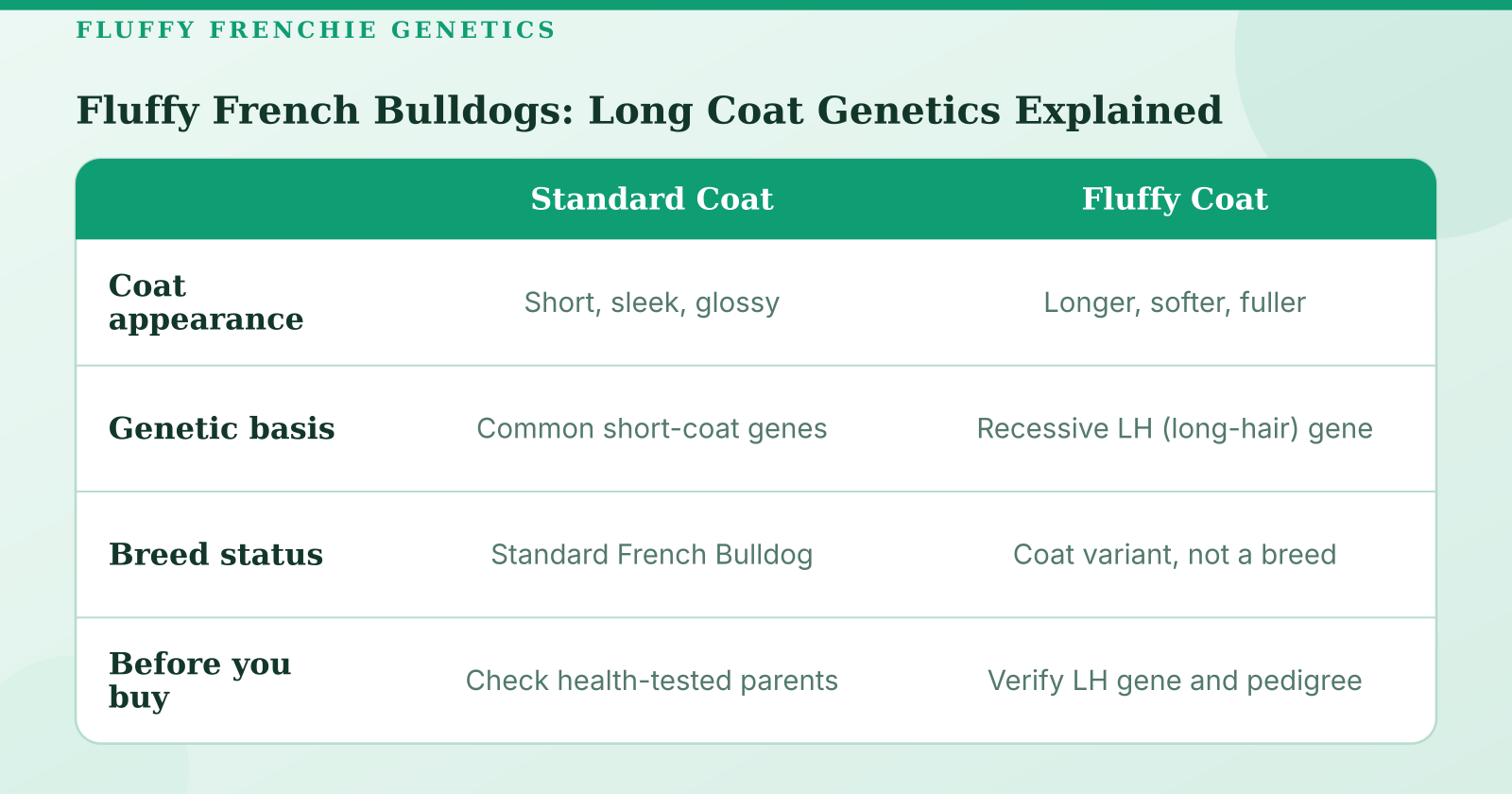
When most people picture a French Bulldog, they picture a sleek, short, glossy coat. Yet across US breeder listings in Los Angeles, Chicago, Houston, and New York, a different kind of Frenchie keeps turning up: the fluffy French Bulldog, with a longer, softer coat that catches the eye. Buyers in those cities often see fluffy puppies priced well above standard coats, often several hundred dollars more depending on the breeder and region, and that gap raises a fair question about whether the coat type is a genuine genetic trait or a marketing label. The short answer is that the long coat comes from the LH (long-hair) gene, a recessive variant that appears under specific breeding conditions. It is not a separate breed. Johnson House Bullies, a French Bulldog breeder in Medina, Tennessee, has written a fuller educational walkthrough of the history and genetics in its fluffy French Bulldog origins resource, and this article uses that material as its starting point.

The aim here is practical. A fluffy puppy should be evaluated on documented evidence, such as lab results, pedigree records, and a written contract, rather than on the appealing photos that dominate listings. The sections below explain where the coat came from, how the LH gene is inherited, what to verify before paying, and where buyers and breeders most often go wrong. Much of what circulates online blurs documented breed history with undocumented coat-variant history, so keeping those two apart is the first discipline a careful buyer needs.
Second, trace the pedigree and check that carrier status can be explained across the line
- Buyers expecting smooth-coat maintenance can be unprepared for the weekly commitment a fluffy coat requires
- Overlooking breathing concerns because a puppy is fluffy and appealing is a serious mistake, since the brachycephalic structure is identical in a fluffy Frenchie and a smooth-coated one
- Third, assess the puppy by video or in person at an age consistent with the breeder's claims, noting that coat changes over the first months
- Its origins are only partly documented, and the most reliable protection for a buyer is evidence: lab results, a readable pedigree, health records, and a clear contract
Where the Fluffy Coat Came From
The French Bulldog's broad development is reasonably well recorded. The breed emerged in the nineteenth century, when smaller bulldog-type dogs from England and France crossed into the lace-making communities of Normandy and Paris. The compact, bat-eared dog that resulted became a fashionable companion in urban France and later in America. Those early records describe type, size, ear shape, and temperament in detail. They rarely treat coat length as a deliberate feature, and that gap is why the history of the long-haired variation is so hard to pin down.
The exact origin of the long-hair variation is not fully documented. Breeders commonly believe the LH gene has been present in the lineage since the breed's early days, surfacing occasionally in litters and receding as breeders favored smooth coats. That account is plausible, because recessive traits can persist unseen for generations before they show. But it remains a hypothesis rather than a proven record. Anyone who claims with certainty when the gene entered the breed, or which dog first carried it, is going beyond what the surviving evidence supports.
Some accounts suggest outside crosses may have introduced the trait in more recent decades, with breeders mixing in another long-coated breed to produce fluffy puppies quickly. This is also plausible and circulates in breeder discussions, but it is not a documented fact about any specific line. Both explanations can be true in different lines, and neither can be confirmed for a particular dog without its pedigree and genetic test results.
Why were long coats less common? During the breed's working period, its ancestors were valued for compact strength and agility, and a heavy coat offered no advantage. Dogs with thick hair overheat more readily, which matters for any active dog. Breeders selecting for the short, easy-care coat gradually reduced how often the long-hair allele appeared in litters. Long coats did not vanish, but they became the exception rather than the norm.
How the LH Gene Is Inherited
The LH gene is a recessive allele, and that is the key to understanding why fluffy puppies are uncommon but not impossible. A dog needs two copies of the long-hair allele, one from each parent, to display the long coat. A dog with a single copy looks like a standard smooth-coated Frenchie because the normal allele masks it. These dogs are carriers, and they explain why fluffy puppies can appear in litters from parents who both look entirely standard.
Carriers are easy to overlook because they look, move, and behave like any other smooth-coated French Bulldog. The only reliable way to know carrier status is genetic testing. When two carriers are bred, each puppy has a chance of inheriting two copies and therefore a fluffy coat. The standard logic for recessive traits applies: with two carriers, roughly one puppy in four would be expected to be fluffy, about half would be carriers like their parents, and about one in four would inherit two normal copies. These are averages across many puppies, not guarantees for any single litter.
The arithmetic changes with the parents. If one parent is fluffy and the other is standard with no long-hair allele, no puppy can be fluffy, and every puppy will be a carrier at most. If one parent is fluffy and the other is a carrier, about half the puppies can be expected to be fluffy. Learning this simple pattern is the most useful step a buyer can take before accepting any litter claim, because it tells you what the parents' genetics should produce and lets you ask precise questions.
Coat length is also only one of several coat traits. Texture, density, feathering on the ears and legs, and shedding are influenced by additional genes, so two fluffy puppies can differ noticeably. A puppy's coat may also change during its first months as the adult coat comes in, which is why a fluffy-looking eight-week-old is not always a fluffy adult.
What to Verify Before You Pay
Because the LH gene is invisible in a puppy and can be carried silently by smooth-coated parents, the most important step is verifying genetics rather than accepting a verbal assurance. Ask for the lab report for both parents' long-hair testing, not a sentence in an email. A reputable breeder keeps these results on file and shares them readily. Vague answers, hesitation, or a claim that testing is unnecessary are reasons to walk away. Confirm that the report names the dog, lists a registration or microchip number, and identifies the lab, and check that the reported genotype matches what was advertised.
Health screening matters just as much and applies to every French Bulldog regardless of coat. The breed is brachycephalic, so its flattened face can affect breathing, and a responsible breeder should discuss breathing assessments and related airway concerns plainly. Ask about hip and patella evaluations and eye examinations, and request documentation for the parents. A breeder who can say what was tested, when, and with what result is showing the transparency you need.
Pedigree and litter history provide the context to judge everything else. Look for clear lineage records, the female's litter history and spacing between litters, and whether the breeder can explain carrier status across the family. Compare what the breeder tells you with the records you can review, since consistency is a strong signal. Shifting or vague explanations deserve more scrutiny than an open admission of what is and is not known. Readers curious about the lineage behind today's dogs can follow the story of fluffy French Bulldog origins, which traces how occasional long-coated individuals appeared within a breed otherwise known for its short, smooth coat.
Price needs careful reading. Fluffy puppies generally carry higher expectations than standard coats in the US market, and listings in major metro areas vary widely. Instead of fixating on one number, compare what is included: genetic testing, health screening, registration, vaccinations, and a contract spelling out health guarantees. An unusually low price can signal cut corners on testing, while an unusually high price without documentation should prompt questions rather than a deposit. Get everything in writing before any money changes hands.
Your environment should factor in as well. A long coat behaves differently in a humid Houston summer than in the dry heat of Phoenix or the cold, wind-driven winters of Chicago. Heat sensitivity is already a concern for brachycephalic dogs, and a heavier coat adds thermal load in hot, humid weather. Buyers in cold climates may find the coat comfortable outdoors but still need to watch for overheating indoors. Thinking through local climate before buying shows whether the coat fits your daily life.
Common Mistakes Buyers and Breeders Make
One frequent error is treating the fluffy coat as a separate breed or a guaranteed designer variant. It is neither. It is a coat-length expression of the French Bulldog produced by a recessive gene, and its appearance in a litter depends entirely on the parents' genetics. Buyers who think they are purchasing a distinct breed may overpay for a label rather than for documented traits. Breeders who market fluffy Frenchies as a special category can mislead buyers about what they are actually getting.
Accepting "fluffy" as a marketing word without genetic proof is another common mistake. A puppy that looks fluffy at eight weeks may not keep that coat as an adult, and a puppy described as fluffy may simply have a standard coat still growing in. Without test results there is no reliable way to know whether two copies of the long-hair allele are present. Much of the later disappointment can be avoided by asking one question before purchase: can I see the genetic test results for both parents? Buyers who want a fluffy French Bulldog increasingly look for breeders who document coat type and lineage, and some begin with resources such as the Johnson House Bullies material on coat varieties and temperament, which describes these traits in plain terms. Key takeaways for any buyer are simple: verify with paper, not description.
Breeders make mistakes too, sometimes by pairing carriers without understanding the odds. Repeatedly breeding carriers can concentrate the trait within a line, and when this ignores health screening it can compound problems. A thoughtful breeder balances coat goals against overall health, temperament, and the long-term soundness of the line rather than chasing a particular look.
Grooming demands are often underestimated. A longer coat needs regular brushing to prevent tangles and mats, attention to facial and body skin folds, and careful ear cleaning. Being honest about your time and budget before bringing a puppy home prevents a great deal of frustration.
Finally, the health implications of the breed's structure apply regardless of coat type. The fix for each of these errors is the same: ask specific, documented questions and be willing to walk away from vague answers.
Putting It Together: A Buyer's Verification Routine
- Without test results there is no reliable way to know whether two copies of the long-hair allele are present
- Repeatedly breeding carriers can concentrate the trait within a line, and when this ignores health screening it can compound problems
- A longer coat needs regular brushing to prevent tangles and mats, attention to facial and body skin folds, and careful ear cleaning
- Fourth, review health clearances and registry paperwork, and confirm the contract includes a refund or replacement clause if the coat claim fails
A workable routine follows a clear order. First, request the written genetic report for both parents and confirm it matches the advertised coat type. Fourth, review health clearances and registry paperwork, and confirm the contract includes a refund or replacement clause if the coat claim fails. Price should then be judged against what is documented, not against the word "fluffy."
The fluffy coat is a real, heritable expression of the French Bulldog, produced by a recessive LH gene that two carriers can pass to a puppy. Buyers in Los Angeles, Chicago, Houston, New York, and elsewhere who insist on that paperwork will pay for a documented trait rather than a label, and they will be far better placed to raise a healthy, well-matched companion.